Monday, December 2, 2013

The "worst cover ever" of "The Final Countdown" and the resulting harmonic implications

You should watch and enjoy this gem first:


Now that you've watched it once, watch it again and listen to the first few chords. Oh man, so wrong, right? Funny funny ha ha. I felt the same, at first. But for me, something felt and sounded really good about those first few chords. But why? After a little thought I figured it out.

What is going on in this video? It's pretty simple, I think. The kid playing the synth lead is playing in F minor. The song is actually in F SHARP minor, which suggests that he is either playing it in the wrong key or, perhaps more likely, his guitar is tuned down a half step. The other guitar, in addition to being rather out of tune with itself, is tuned to standard tuning. She is also simplifying all of the chords to root-plus-fifth power chords. After two or three listenings I realized I was quite drawn to the sound of this. Here's a quick breakdown of this wonderful fiasco:


If you take the F minor line and turn the "horizontal" into the "vertical," you get some good sounds:
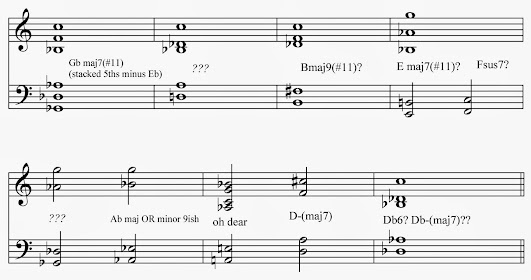

Interesting that some of the minor chords from the original become major, and the major chords become chromatic disaster chords (chords with three adjacent pitch classes, like C, Db, and D, that are hard to name with the standard symbols). All of this contains a lot of possibilities (if you're me). Here's a Bach chorale-style treatment:


Another possibility is a goofy bossa nova number, like this:


Love that F minor pentatonic shit over Gb major! Oh YEAH!

So anyway. My point is that sometimes you find "inspiration" (whatever that means) in the strangest places.

Tuesday, November 19, 2013

Train (wreck) kept-a-rollin'

I was working on a post about the bass playing on Aerosmith's "Sweet Emotion" and wasn't really satisfied with my writing. The tone was wrong. So I amused myself by finding "bass lessons" on YouTube. Hilarious, as always. But I also found this curiosity:


Ok, so...Tom Hamilton's bass sounds like ass. His tone, as it turns out, is also wrong. And he has phones on his bass. And the dude looks like a lady. (I'm sorry. Not that sorry, really.) BUT. What the hell happens at 1:31? The drums are a beat late! And any performer, musical or otherwise, knows that the next question...whether spoken or not...is...

(And I know, we're supposed to work through these moments together. As a team. Or as a family (barf). But come on. We all wanna point fingers. Don't deny it...)

Who is to blame?????????

NOT Tom Hamilton. He's a champ. Steady throughout this mess (other than the beginning, I guess--though I think Joey Kramer started too fast). And he quickly adjusts to this weirdness. So what is happening here? Here's my analysis.

0:26 Bass enters, considerably slower than the drums.

0:50 Joe Perry comes in with his Talk Box junk. But it sounds really weird, like something is wrong with the tube. Or his mouth.

1:17 Steven and Tom are staring at Joe Perry, like "What the fuck, man??" This is also the moment when Joey Kramer hits the bass drum on beat 2 instead of beat 1. So someone was trying to readjust the whole thing. I'm guessing Steven Tyler did this.

1:20 Steven Tyler is glaring at Joe Perry! Awesome rock star shit, here.

1:23 Joe Perry looks...really lost/confused.

1:31 This is when anyone that's paying attention has some real fun. WHOOOOOAAAAAAA, here we go!

1:38 Steven Tyler is...trying to settle/slow down the tempo? I'm not sure. There seems to be disagreement about the tempo from the start, actually. The best part is Brad Whitford noodling stage right the whole time, in the dark and shaking his head. I assume. I've always figured that was his role in a band led by a couple of clowns.

It's a harrowing minute and a half for me. Fascinating and uncomfortable to watch. So what happened? Here are my guesses.

-Joe Perry was out of it for whatever reason. However, Steven Tyler overcompensated by cuing the wrong downbeat after following Joe Perry's meandering Talk Box stuff. Gurgle Box, more like it.
-Joe Perry couldn't hear the bass in his monitor.
-Joey Kramer couldn't hear the bass in his monitor.

That was in order of likelihood. But I also think that Steven Tyler tried to be the boss and made things worse. Shame on Joey Kramer for taking orders when he had it right all along. And kudos to Tom Hamilton for hanging in there, junk tone or not. But wow, even after the botched intro, a muddled, TERRIBLE performance. And the Talk Box never sounds right.

And if you make it to 4:45...the burning speaker cab thing is the dumbest gimmick I've seen in a long time.

It's hard being an Aerosmith apologist. Very hard, indeed.

Wednesday, November 13, 2013

Apt to be pinched

I'm pretty good at writing for different instruments. I get it. How the different ranges work and sound. Especially winds. But I never knew...until today...how sexy orchestration can be.

This is from my Kennan/Grantham 5th edition orchestration book:


Oh my.

Weak, breathy. Stronger. Powerful.
Piercing. Oh dear.
Thick. Oh yeah.
Reedy, sweet, intense. Yeah, I don't know what "reedy" insinuates, either.

And my favorite..."Apt to be pinched."

Yes. Woodwind registers according to Kent Kennan. So damn sexy.

Sunday, October 6, 2013

The difference between D sharp and E flat


Anyone that works with me knows that I am a nerd about...everything. But especially note spelling. Sharps vs flats, etc. And I always come off as pedantic or as an asshole. Usually the latter. For me it's simple:

1) Is it correct spelling in the context of the harmony/key? (The key is E major. No, that is NOT an A flat minor chord.)
2) Does the note choice facilitate easier reading melodically? (Reading C sharp to E flat kinda sucks.)
3) Some combination/give-and-take of 1 and 2.

But that's not always enough. These are not heard examples. Those cases are fine on paper, but what about sound? Who cares if we call a D sharp a D sharp or an E flat?

Tonight I heard a great example. It's actually a great, familiar example of a number of things. And it helps that the verses and chorus are the same harmonically.

Radiohead, "Creep"

This song has two classic pop/rock harmony cliches:

-a major three chord (III) that moves to IV
-a IV chord that becomes minor (iv)

And here's where I can talk a bit about the difference between D sharp and E flat. The guitar plays different broken arpeggios of the following:

The chromatic line D, D#, E, Eb, is quite plain. And even out of context that makes sense: the non-diatonic note is spelled with a sharp ascending, flat descending.

But for nerdy/pedantic/asshole purposes that is not enough. Context is most important. In the key of G major, a chord built on the third scale degree is B major. Obviously. And a chord built on the fourth scale degree with a flatted third is C minor. Yes. Ok.

But beyond that...what is the difference between a D sharp as part of a B chord and an E flat as part of a C chord?

It's possible that not everyone hears this the way I do, and maybe it seems really obvious, but...man, I hesitate to say this word...the psychological effect of the D sharp is so very different from the E flat. I find this terribly profound. In equal temperament, these two pitch classes are the same. Yet within the contexts of B major and C minor triads, they mean such different things.

Just listen to the song, and listen carefully for that chromatic line. It's the harmonic and emotional backbone. Doesn't the D sharp sound bright? It "lifts." While the E flat is so dark. It really pulls down to the D, which is part of the G chord.

Again, maybe it's obvious. I know it's all mind tricks. Centuries of cultural conditioning. But still.

Am I over-talking this point? Eh. But I find it so interesting. And it's all tied to note spelling and context. So there. I may be pedantic AND an asshole. But sometimes I'm right.

Tuesday, September 24, 2013

My relationship with "Livin' On a Prayer" is complicated


My relationship with Bon Jovi's "Livin' On a Prayer" (song and video) is complicated. Mostly I think it kicks major ass. But I must temper this enthusiasm. The following points outline my predicament.

PROS:
1) The song itself is pretty solid. I was not surprised to find Desmond Child's name in the writing credits.
2) The talk box guitar hook is a classic.
3) The bass line during the verses, pedaling on the tonic under i, VI, and VII in E minor is great.
4) For 80s hair/glam/whatever the hell this is, I like the sound of the recording. Solid band.
5) The video is a great concert video, complete with a "black and white rehearsal" versus "color concert footage" gimmick. Love that shit. Oh, and flying for no reason.

CONS:
1) The video has absolutely nothing to do with the lyrics. The song is about a young couple struggling financially. So much so the guy has to pawn his guitar. This video seems to be about a bunch of overpaid young guys from New Jersey flying for no reason.
2) The song's most distinctive feature is the talk box guitar hook. The song has the line "Tommy's got his six string in hock. Now he's holding in when he used to make it talk." GET IT? TALK?! Sort of on the fence with that bit. Mostly I think it's stupid.
3) The bass line in the chorus is dumb/bad/too much. The walky-arpeggio stuff. No one cares if the bass player knows what notes are in the chord. Really. I mean, people say they care...but...I mean...after that cool E pedal for the verse, the line in the chorus is over-clever and dopey sounding.
4) I guess someone thought that shitty arpeggio line going from I to IV was soooo great it's part of the guitar solo (3:02, 3:10)! What a goofy, stupid idea.

So I'm at an impasse. These sort of balance out. No...but...WAIT. WAIT JUST A MINUTE.

After the solo...going into the end-chorus-vamp-fade-amahjig at 3:23?!

PROS, TOTAL F'ING REDEMPTION:
1) They drop a beat before they do the modulation.
2) They go up a goddamned minor third!

So there you have it. "Livin' On a Prayer," Unbehind-approved.

Thursday, September 12, 2013

Old Mother Hutty

I got this rhyme from my father. If you say it quickly and mess up you might say a naughty word.

Old Mother Hutty had a cutty putty hunt.
Not a hunt punt cutty,
But a cutty putty hunt.

If you trust Urban Dictionary (ha HA!), "cutty" means something synonymous with the dirty word.

I've found other versions, usually involving boats:

Old Mr. Hunt
had a cuddy punt
Not a cuddy punt
but a hunt punt cuddy.


But I like my Dad's version. He said it sorta like this:


And my brother did it this way:


Which is the point: get drunk and say this as fast as you can until someone accidentally says c***, then laugh and drink some more.

But something I noticed recently is that this sounds a lot like a snare drum marching cadence (audio here):

I haven't found much online. I can't prove there's a relationship here. But it's interesting.

Tuesday, September 10, 2013

More stuff that isn't really in 7: Pink Floyd and the Bee Gees


Music that is actually in 7 is hard to find, and the following examples are no different. Sure, 4+3=7. But you still hear the split. And unlike "The Ocean," there's no 7/8 "clave" splitting the measure up. These are made up of measures of 4 and 3, though the effect achieved in each is quite different.

The first song I ever heard "in 7" was probably "Money" by Pink Floyd, written by Roger Waters. It's anchored by the following bass line:
And that notation is ok. But without that dashed line my eyes get lost. Isn't this more accurate?

I like notation to do more than tell me what the notes are. It's always better when it gives me more, and clearer, information. In this case it's clearly 4 beats + 3 beats. Just listen to the drums. The really cool thing about this line is that it's 7/4 by deletion AND elision. It's really the following line minus the last note (deletion):
The note that you might imagine as the last note of the two bar pattern in 4/4 becomes the first note of the 7 pattern (elision). Pretty cool.


"Jive Talkin'" by the Bee Gees does something quite a bit different. Here's the sweet-ass major pentatonic synth lead during the instrumental breaks (1:16):
Wait. Is it this?
 Actually, listen to the drums. The drums play in 4/4 straight through!
 
So to my ears, this is the most natural way to bar it. I like the strong 4/4 bars at the beginning and end of the 4-bar groups. Take a few listens and see if you agree:

Though really, I just think it's a 7 beat line repeated and superimposed over 7 measures of a 4-on-the-floor drum beat. Wicked sweet.

I love dancing.
