Sunday, March 31, 2013

More flams than you can shake a stick at!


Plenty has been said and written about Stewart Copeland's playing with The Police, but I want to focus on a very small aspect of it--an astounding number of songs that The Police recorded have either very short or somewhat long drum solo introductions. Some are a full four+ measures long, some are just one beat. This is a catalog of all(?) 30 of them, taken from the Message In a Box four disc collection. ("Box set"...I almost don't remember what that even means...). I'm not sure when or why I became obsessed with these intros, but they're all such great little gems. All of these songs could have started with the full band on a downbeat. But I'm glad they don't.

After searching around online, I've decided not to worry about sticking to any notation protocol. Every chart I find is slightly different, so I just wrote something that seems passable, and the description should clarify any uncertainty. Drummers: feel free to let me know if anything is way off in terms of notation or what you hear.

I have included links to YouTube videos, all of various audio quality and some could be taken down at any moment. Spotify works great if you're really interested in checking these out.


The first two tracks were released as a single in the UK:

1. Fall Out
This gets us off on the right foot. Well. Literally. And with a flam on the snare. There are plenty more of those.

Another flam, this time without the bass drum.

From Outlandos d'Amours
Let's call this a modified "blackum": the typical snare flam followed by the bass drum, except with snare drum hits with the bass drum and toms at the end.
4. So Lonely
A single "blackum": snare flam followed by bass drum.
5. Roxanne
Just one eighth on the open hi-hat, then the guitar enters.
6. Peanuts
Tom pickups into two measures of driving, open hi-hat beat. There's a transcription online that has eighth notes in the hi-hat in measure 2, but I hear a closing hi-hat "shht" sound, not a stick sound.
7. Can't Stand Losing You
Maybe I'm hearing things, but I hear snare, crash, AND closed hi-hat on beat 4 of this intro. I think the cymbal was overdubbed.
8. Truth Hits Everybody
Another bass-flam pickup.
B-side of the "Message In a Bottle" single:

9. Landlord
Another snare flam on 4.
From Regatta de Blanc

10. Deathwish
This is classic Stewart Copeland shit: hi-hat and rim clicks with shifting accents.


11. Walking On the Moon

The drum track for this song is well-known for its use of a delay effect, but the intro is just the hi-hat (and guitar amp noise), no delay.

12. On Any Other Day

I've included Stewart's spoken part with the snare drum intro. It flows pretty well.
13. No Time This Time
Choo-choo train intro. He kinda muffs the fourth bass drum hit.

B-side of the singles "Don't Stand So Close to Me" (UK), and "De Do Do Do, De Da Da Da" (U.S.):

14. Friends
This one took me awhile. I kept hearing it an eighth-note off with the splash cymbal on the "and" of 3 instead of on 4.
From Zenyatta Mondatta:

15. Driven To Tears
A modified "blackum," with hi-hat closing in place of bass drum.
16. When the World Is Running Down
Double flam! Flam it good! Flam it right! Flam it TWICE!
17. Bombs Away
One tom and the snare. This project has reinforced something I already knew but had never paid such close attention to: drums can sound really different depending on how hard they're hit.
18. Man In a Suitcase
More signature stuff: splash cymbal and a really high-pitched tom.
19. Shadows In the Rain
Hi-hat alone.

B-side of the singles "Invisible Sun" (UK), and "Every Little Thing She Does Is Magic" (U.S.):

20. Shambelle
Another boom-flam. These are technical terms.
From Ghost in the Machine:

21. Spirits In the Material World
This was another tricky one, mostly due to the synth.

22. Every Little Thing She Does Is Magic

A simple hi-hat intro made more intricate with a stereo panning delay effect. Repeats are at the 1/16 note. This is the sounding intro--he probably played half as many notes.
23. Hungry For You
A single snare hit. No flam.
24. Demolition Man
This one is tough for me. Honestly I can't make out nine individual attacks. But I saw it written this way online and I'm going with it. In some ways the strangest of all the intros.
25. Rehumanize Yourself
Flam it. Flam HARDER. FLAM AGAIN!
26. One World 
I found a transcription of this that notates it in 4/4 with a lot of triplets. It's a tough call, but I like my way better: a modified shuffle with straight elements. Really cool feel. Stupid lyrics, but rhythmically very interesting.
From Synchronicity:

27. Miss Gradenko
This intro features a high-pitched octoban.
28. Every Breath You Take
This quarter-note pickup features another non-standard addition to the kit: gong drum.
29. Wrapped Around Your Finger
This is either a splash cymbal or some other small metallic thing-a-ma-jig.
30. Murder By Numbers
This is perhaps the drum intro. My transcription is only the first two measures, but it shows several Copeland hallmarks: the off-putting splash cymbal downbeat, the cross-cutting rim clicks, and the strong two and four on the bass drum. I actually found a transcription of this that put the bass drum on one and three at the beginning of the verse, then turns it around with a 3/8 measure. Which...makes no fucking sense. (Must be getting to the end of the post...he's cursing!) The whole point is that the verse is a modified one drop/shuffle pattern and the chorus shifts to a heavy shuffle with a backbeat. Anyway. Great tune. Great drumming.


Monday, March 18, 2013

cheese+cheese=GOLD

I'm a sucker for drunk, lonely single guy songs. Hm. But anyway. Frank Sinatra's are my favorites. The more over-the-top, the better. In fact, sometimes I think that if your starting point is corny, all you need to do is lay it on really, really thick and it comes back around the circle to the amazing point. Take this song, for example:


"A man who knows love is seldom what it seems, only other people's dreams." Oh YEAH! But what really makes it is Don Costa's string arrangement, especially at 2:25:


I can't tell you how many times I've listened to this in the car in the past week, and each time I've said, out loud, something like AWWWWWWWWWWWWWWWWWWWW YEEEAAAAAAAHHHH! HOLY SHIIIIIIIIIIIIIIIIIIIIIIIIIIIIIIIIIIIT!"

What a great six measures of music! It begins with a simple statement of the tune, then all of those sixteenth-note triplets, then the completely out of hand counterpoint to Frank...in three octaves at the end of it! It "should" end when he comes back in, but no, it keeps going, and goes HIGHER! Oh, oh, oh. Such good writing.

Let's not forget the celeste at 2:52 Sometimes...all your cheese needs is a little more cheese. This is GREAT cheese.

Friday, March 8, 2013

Phil Collins abides

I love "Against All Odds" by Phil Collins. I really do. And that's in spite of a few things I truly can't stand, none of which are related to unfashionable (by today's standards) production techniques.

Let's start with the introduction. While perfunctory, it's an excusable, ii-V upbeat to the verse. But next is the verse. Have mercy. The first two measures are, to me, some of of the most dashed off, junky ideas ever:
Allow me to explain. Root motion by step is dangerous territory. This climb from vi to ii is ugly stuff, especially that ii chord. It sounds...wrong, doesn't it? Not sure what it "should" be, but that ii chord is an incredible non-moment. Even just an E flat sus sounds better. As skeptical as I am of the stepwise root motion, there is some sort of momentum built by that climb...that is subsequently ruined by that ii chord.

To top it off, the melody is almost completely parallel with the bass/roots...in octaves. Ugh. Not in a chorale-style theory class way, just in an extra friggin' ugly to my ears sort of a way. And this continues through the verse: melodic emphasis of the roots, though it is somewhat masked by some simple scale work and arpeggios. I do like the Ab/Gb sound, and it resolves to F-7, which is smooth and fine.

But. All is saved by the chorus. Oh have mercy, the chorus. The other kind of "have mercy." The first two chords comprise one of my favorite moments in music:
No perfect authentic cadences here! It's a I chord with the fifth in the bass which moves to what?! Yes! V7/V over the A flat pedal! Phil has been redeemed! Not for all of his patchy creative output, no, but for the iffy beginning to that verse, at least! And the tune is better! And he screams a B flat! Hooray for Phil!

So there are two root position tonic triads in this song: one is part of that iffy ascending bass thing,and there's a quick one in the ending. The ending is just as perfunctory as the beginning, with the unfortunate, faux-thoughtful "last chord on V." Oh well.

But that chorus kicks ass!

You know what else I love? Gated reverb on the drums. I don't care what anyone says. You know what else is great? This video.

The Dude vs James Woods, who is, of course, the bad guy, because he has facial scarring

Jeff Bridges as the lovable rogue! James Woods being bad, apparently. Anyway. I love this song. Mostly because of one chord. And a snare drum that sounds like a Casio keyboard drum pad. But I love it.

Sunday, February 10, 2013

Channel 2 yeah count on us.


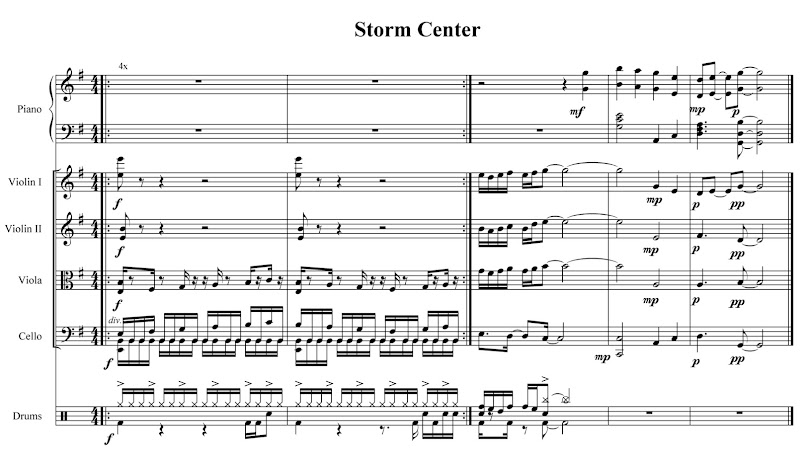
So now that we've mostly dug out from the storm with the worst name since Hurricane Bambi, we can organize an ensemble to play the Storm Center music. (editor's note: I'm talking about 2013's "Nemo.") Perhaps you saw my post on Facebook already--the short story is that if you grew up in Maine, this music meant it was time to keep your eyes glued to your local NBC affiliate (Channel 2 in Bangor, Channel 6 in Portland, and early in the morning it was often the Portland crew on both) and wait for your school district to scroll by on the bottom (Come on MSAD 67! COME ON, KEVIN MANNIX!).


I made the transcription from the video and from memory. It's not bad. I think the actual music might have live cellos and synth strings along with sequenced drums and maybe acoustic piano. Not sure. All of it has some rather icky reverb.


Stawm Centah, bub. Cellos and shit. Celli, 'n' whatnot. Ain't no friggin' way them busses is gettin' up the Transalpine today.

Technically I should have put some decrescendos in and a poco rit, but close enough.

Wednesday, January 23, 2013

His hair was perfect. Unlike the cadences.

This morning I realized something. Something I should have realized by now. It's not news that "Sweet Home Alabama" and "Werewolves Of London" are very similar, at least in terms of chord progression/harmonic rhythm and tempo (most of the former and all of the latter are, for the most part, D followed by C followed by G, over and over). I mean even Kid Rock knows that. And I've used "Sweet Home Alabama" as an example of "be careful of what the chords LOOK like, never forget what they SOUND like," especially when combined with the vocal melody: the song is in D, the chords being I, flat VII, IV. And the signature guitar lick--the one that comes right after the title is sung during the chorus--is D all the way.

The thing that blew my mind was I'd never gone back to "Werewolves..." to check it out. Never even thought of it. I was thinking about it today, and in my head I realized HOLY CRAP it's in G! Sure enough, the vocal...well...it's hardly a melody...more of a half-recited...part, I guess, is mostly the pitch G. And the "aa-OOO" part? Yes. That's a higher G.

I'm not going to bother making diagrams. If you're inclined to check this blog out then perhaps you're the type of person that will check this for yourself. But in both cases what I think of as "key" is determined not by the chord progression so much as the vocal line tying things together.

NOW. What REALLY blew my mind is that the guitar solo in "Sweet Home Alabama" is clearly based around G! The chord progression stays the same, but the guitar solo is totally "G-centric." Mostly a sort of bluesy major-pentatonic sound.

So does this ruin my theory? Not really. I still maintain that most of the tune is firmly in a modified D major (not comfortable calling it "the key of D mixolydian"--that's not how I interpret this music--it is NOT modal, it is INFLECTED). However, it does make me think differently about both songs. Rather than getting stuck on the "chord progression," it may be more useful to think of these progressions as loops--a series of chords over which any number of melodies/lines/riffs can be overlaid, thus changing the identity of the loop. "Werewolves Of London" ends up sounding like G major, while "Sweet Home Alabama" sounds like either D or G depending on the section.

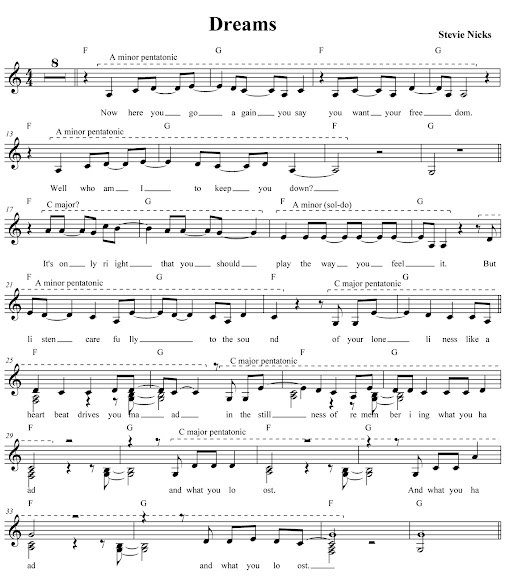
This is much like "Dreams" by Fleetwood Mac--the two chord progression is more like a simple vamp that Stevie Nicks sings over the top of. At times you hear A minor, other times you hear C major.

Oh. And that profoundly stupid Kid Rock song is in G. Again, because of the vocal melody. He does drive a really sweet boat in the video, I gotta say. And there are girls and stuff.

An interesting side note: Mick Fleetwood and John McVie, the namesakes of Fleetwood Mac, play on "Werewolves Of London."

Friday, January 11, 2013

Linear tonics, continued

I've described "linear tonics" before, and I've mentioned this example, but I thought I'd break it down a little bit. Yes, if you think that a tonic requires some sort of harmonic event--that a tonic is only as good as its dominant--then yes. I'm full of crap. But it you believe it's possible to write a piece of music in a key without some sort of cadence on a tonic chord then maybe you'll agree with me on this. My basic argument is that this song is written in and "around" A minor/C major, without any sort of cadence on either. Until someone tells me otherwise, I'm referring to this phenomenon as "linear tonic."


The verse consists of an A minor/C major melody accompanied by F and G major chords.


The chorus is basically the same, the melody harmonized with simple triads (C, F, A-), resulting in various major-ey, diatonic-ey harmonies.


The rest of the tune works basically the same way. This is a song in A minor and C major. If you think a "key" requires a "cadence," then let's not argue. We won't get anywhere. But. If you agree that the melody means more than the chords (chords are NOT synonymous with harmony), then let's talk. And if you think the chord at 1:50 sounds like the tonic, then yes. I think you're right.

Wednesday, November 14, 2012

Unintentional field study: The Beggar Duck


This post started off as a goof on several levels, but quickly became far more interesting than expected. It began with my mild obsession with this web discovery last week: ducks wearing dog masks. Today I had the opportunity to capture video, and the visual effect is, to me, pretty stunning and hilarious:


I posted this on Facebook, and my college friend Matt jokingly (?) suggested I transcribe the duck sounds. So I thought why not? It didn't take long to realize that the duck isn't quacking randomly. It's almost a sort of Morse code, with short and long notes:


I used a sort of inflected 4/4 time because it's convenient. The measures of "1/16" could be notated as ritards, perhaps, but I like trying to keep it steady. That feels a little more honest.

I actually took two videos today; the other is pretty similar:


This is far from my area of expertise, but there seems to be some sort of pattern. Is this related to what a duck learns as a duckling, expressing hunger? Or is it simply "Look at this chump with a camera phone. Let's scam some stale bread out of him!" (For the record: I do NOT feed the ducks. I'm a good citizen.)