Wednesday, January 23, 2013

His hair was perfect. Unlike the cadences.

This morning I realized something. Something I should have realized by now. It's not news that "Sweet Home Alabama" and "Werewolves Of London" are very similar, at least in terms of chord progression/harmonic rhythm and tempo (most of the former and all of the latter are, for the most part, D followed by C followed by G, over and over). I mean even Kid Rock knows that. And I've used "Sweet Home Alabama" as an example of "be careful of what the chords LOOK like, never forget what they SOUND like," especially when combined with the vocal melody: the song is in D, the chords being I, flat VII, IV. And the signature guitar lick--the one that comes right after the title is sung during the chorus--is D all the way.

The thing that blew my mind was I'd never gone back to "Werewolves..." to check it out. Never even thought of it. I was thinking about it today, and in my head I realized HOLY CRAP it's in G! Sure enough, the vocal...well...it's hardly a melody...more of a half-recited...part, I guess, is mostly the pitch G. And the "aa-OOO" part? Yes. That's a higher G.

I'm not going to bother making diagrams. If you're inclined to check this blog out then perhaps you're the type of person that will check this for yourself. But in both cases what I think of as "key" is determined not by the chord progression so much as the vocal line tying things together.

NOW. What REALLY blew my mind is that the guitar solo in "Sweet Home Alabama" is clearly based around G! The chord progression stays the same, but the guitar solo is totally "G-centric." Mostly a sort of bluesy major-pentatonic sound.

So does this ruin my theory? Not really. I still maintain that most of the tune is firmly in a modified D major (not comfortable calling it "the key of D mixolydian"--that's not how I interpret this music--it is NOT modal, it is INFLECTED). However, it does make me think differently about both songs. Rather than getting stuck on the "chord progression," it may be more useful to think of these progressions as loops--a series of chords over which any number of melodies/lines/riffs can be overlaid, thus changing the identity of the loop. "Werewolves Of London" ends up sounding like G major, while "Sweet Home Alabama" sounds like either D or G depending on the section.

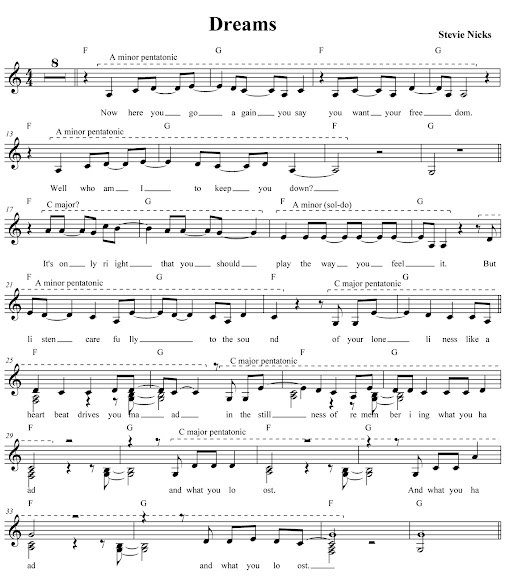
This is much like "Dreams" by Fleetwood Mac--the two chord progression is more like a simple vamp that Stevie Nicks sings over the top of. At times you hear A minor, other times you hear C major.

Oh. And that profoundly stupid Kid Rock song is in G. Again, because of the vocal melody. He does drive a really sweet boat in the video, I gotta say. And there are girls and stuff.

An interesting side note: Mick Fleetwood and John McVie, the namesakes of Fleetwood Mac, play on "Werewolves Of London."

Friday, January 11, 2013

Linear tonics, continued

I've described "linear tonics" before, and I've mentioned this example, but I thought I'd break it down a little bit. Yes, if you think that a tonic requires some sort of harmonic event--that a tonic is only as good as its dominant--then yes. I'm full of crap. But it you believe it's possible to write a piece of music in a key without some sort of cadence on a tonic chord then maybe you'll agree with me on this. My basic argument is that this song is written in and "around" A minor/C major, without any sort of cadence on either. Until someone tells me otherwise, I'm referring to this phenomenon as "linear tonic."


The verse consists of an A minor/C major melody accompanied by F and G major chords.


The chorus is basically the same, the melody harmonized with simple triads (C, F, A-), resulting in various major-ey, diatonic-ey harmonies.


The rest of the tune works basically the same way. This is a song in A minor and C major. If you think a "key" requires a "cadence," then let's not argue. We won't get anywhere. But. If you agree that the melody means more than the chords (chords are NOT synonymous with harmony), then let's talk. And if you think the chord at 1:50 sounds like the tonic, then yes. I think you're right.

Wednesday, November 14, 2012

Unintentional field study: The Beggar Duck


This post started off as a goof on several levels, but quickly became far more interesting than expected. It began with my mild obsession with this web discovery last week: ducks wearing dog masks. Today I had the opportunity to capture video, and the visual effect is, to me, pretty stunning and hilarious:


I posted this on Facebook, and my college friend Matt jokingly (?) suggested I transcribe the duck sounds. So I thought why not? It didn't take long to realize that the duck isn't quacking randomly. It's almost a sort of Morse code, with short and long notes:


I used a sort of inflected 4/4 time because it's convenient. The measures of "1/16" could be notated as ritards, perhaps, but I like trying to keep it steady. That feels a little more honest.

I actually took two videos today; the other is pretty similar:


This is far from my area of expertise, but there seems to be some sort of pattern. Is this related to what a duck learns as a duckling, expressing hunger? Or is it simply "Look at this chump with a camera phone. Let's scam some stale bread out of him!" (For the record: I do NOT feed the ducks. I'm a good citizen.)

Wednesday, September 26, 2012

Say WHAT?!: bassline telephone

I had no idea what I was getting myself into today. Someone suggested a Chic "Good Times"/Sugarhill Gang "Rapper's Delight" bassline tutorial after my "Cissy Strut" post, and I thought HA, sure, I've always wanted to learn that actual line, myself.


But there was a catch I hadn't expected: the lines aren't the same! I never knew that!


I always thought that "Rapper's Delight" (RD from now on) used a sample of "Good Times" (GT), but no--RD is pre-sampling era. The RD Wikipedia entry discusses it a bit, but the basic story is that the producer paid then 17 year old bassist Chip Shearin $70 to play the GT bassline for 15 minutes (I've seen this referred to as "interpolation"). This raises some very interesting questions, doesn't it? I'm not inclined to start an "authenticity" discussion here, but it does make me wonder--Which is more "authentic": a sample or a recreation of a track using studio performers? Guess it depends on what you mean by "authentic."

I'll leave that line of inquiry to others. But I do wonder about the differences. Were they deliberate? The RD line is a little less syncopated, most notably in measure 2. One of the things that makes Bernard Edwards' line so special is that he doesn't play on downbeats other than in the first measure of the pattern. His playing is also free of the time-keeping ghost/percussive notes in Chip Shearin's performance, and he was clearly recorded using top-notch studio gear (he sounds GREAT on this record).


Is the RD line straightened out on purpose, or is it simply a case of misremembering on Chip Shearin's part? Perhaps learning the line quickly? I'm not sure why the line would be changed deliberately, though the somewhat more "straight" bassline may have been easier for the rappers, and certainly their "flow" is typical of very early hip-hop: straighter, more on the beat. I don't think dodging copyright issues comes into play, because I don't think anyone thought much about it at the time, and the line is almost identical to, and certainly recognizable as, the GT line. I'm inclined to believe it's a case of a young player learning a line quickly and/or simplifying it to something he could easily recreate for 15 minutes error-free.

So this helps explain why a not-so-easy line to begin with is never played "right"--it's like a game of telephone! Like a friend of mine put it (and I hope he doesn't mind the quote): "[these] new performances spread like memes, and all semblance of the "original" is lost!" Not unlike "Cissy Strut".

And as it turns out, Chic's Nile Rodgers and Bernard Edwards made out just fine after threatening a law suit. This short interview is cool. And can you imagine going to a Clash/Blondie/Chic show?!

Monday, September 24, 2012

Simple is hard

"Cissy Strut" by The Meters is one of those tunes. A back pocket tune. A time killer at a gig. A tune so seemingly simple that it's easy to just not learn how to play it "right." And by right, I mean the original version. And the more I listen to it and the more I think about it, the more right it gets. It's so, well, funky. And it's so sparse. And the second riff is so straight! I love that.


I know, I know. It's a simple riff-based tune. Variations galore. Scofield and Lovano can do whatever the hell they want. But it's still important, I think, to know the material you're working with. And I didn't until very recently: I played extra notes, played the first riff totally minor pentatonic, totally missed the A. Embarrassing.

This tune is overdone. And overdone badly. It's great to hear how good the original is.

Along these lines, Ethan Iverson has a great post here about Monk's "Well You Needn't"--similar issues and lots of great discussion.

And if anyone is interested in the curious title "Cissy Strut" this looks great. Honestly, I've only skimmed it, but it's very interesting stuff.

Thursday, September 6, 2012

"linear tonics": "She's Gone" and "Jane Says" revisited

I want to introduce the notion of a "linear tonic": a melody that states the tonic chord in the place of any "vertical" harmonic statements of the tonic. I'm sure there is a precedent for this in analysis, but I have never encountered it. Any unharmonized melody is related to this--solo renditions of The Star-Spangled Banner are perhaps the most common example in this country. Bad performances aside, there's never any doubt what the tonic is, provided the singer is competent and has steady pitch. We've heard the tune thousands of times, perhaps, and often with instrumental accompaniment that gives us all the cues we need to hear and know the key. Gregorian chant is another related example.

But what happens when all of the tonal elements are taken apart and put back together in a somewhat incomplete way? More specifically, what happens when the composer/songwriter takes the harmonic tonic (I chord) out of the picture completely, and instead projects the tonic linearly in the melody? And even more radically, what happens when this "linear tonic" occurs simultaneously with other non-tonic harmonies? That is exactly what happens in the examples cited below.

Perhaps it was my recent Daryl Hall sighting that got me thinking about this again. But it occurred to me that these two tunes have more in common than I originally thought. It's true that both lack a root position I chord (in the case of "Jane Says," no tonic chord at all), but they also share a striking structural similarity: the verse of "She's Gone" and most of "Jane Says" consist of what can be interpreted as a IV-V vamp, overlaid with a melody that is clearly based around the "unheard" tonic I. I'll start with the simpler tune:


I've discussed this in a previous post; my basic assertion is that the tune is in D major, the harmony consists of a IV-V vamp, and the tonic is projected linearly over the top of it. I honestly can't imagine another way to hear/see/think it.


My recent revelation was that the verse of "She's Gone" is very similar, with the added oddity of the B pedal in the bass:


Hall & Oates "She's Gone," verse, IV-V over B


I recently had a conversation with a friend whose thoughts and opinions on music I value very highly, and he said "Well, I always heard some sort of flat VII to I thing here." No. NO NO NO. And this is why: listen to and look at the tune! It's so clearly E major! It's more sophisticated than the Jane's Addiction example but it's the same thing at work: a linear tonic over a IV-V vamp. The chorus makes it even more amazing:


HOLY CRAP WHAT IS THAT AMAZING CHORD AT THE END OF THE CHORUS?! An Amaj9/B?! Again, no. NO NO NO. It's actually the closest thing we get to a tonic chord (besides the passing I6). It's as if the tonic E triad gets stuck after being hinted at up to this point, and it gets suspended over the vague A/B sound, which carries into the next verse. An A major sound, for sure, but far more accurate to hear the layers involved. And it's so crafty in terms of structure: an E triad sounding at the same time as that A/B sound, which almost functions as a "tonic by proxy." And not a coincidence that the lyrics are "What went wrong?" at this moment. It might be a simplistic interpretation on my part, but I appreciate that this lyrical uncertainty (is there ever an easy answer to that one?) is set with a totally non-functional, gorgeous, ambiguous chord.

So linear tonics. I think it's the best way to hear some things. Here's one more:

Fleetwood Mac, "Dreams": A minor, mostly a VI-VII vamp

Tuesday, August 28, 2012

Not quite A flat


Attention Police fans/total dorks/people that like finding answers to obscure trivia online (I know I'm not the only one that fulfills all three):

Why was "Every Breath You Take" recorded at around A=425Hz? That's closer to A flat than A. I don't believe there's another track on Synchronicity like that, and for such a "produced" album with so much new technology this seems very odd.

-Were they tuning to the piano?
-Were they finding a sweet spot for Sting's voice?
-Did they just slow the whole thing down a little? That can't be.

That's really all I've got. One friend suggested they did it for "smoothitude." A good answer, for sure, but not the one I'm looking for.

This isn't the sort of question that will keep me up at night. But it will prevent me from doing laundry, all for the sake of "research." So please, do me and anyone that comes in contact with me a favor and help me out with this.

And for the heck of it...you should watch the video. It hasn't aged well.

So broodity. So Sting-ity.

I love it when the music and video are clearly out of synch, like Andy Summers at 1:07. Oopsie! And Flea's left hand from 3:57 to the end of this one.

Give It Away

It seems like SOMEONE along the way could have synched that up. Man, that band has been putting out wussy junk for a solid 20 years!

But I digress. Any real input on this Police issue would be welcome. Or more out of synch videos. That would be ok, too.
