Thursday, April 12, 2012

Yeah, what Arto said.

"Listen to the Ambitious Lovers, the whole idea was Al Green and samba. That against this; this against that; a blend, a juxtaposition, loud/soft. There's no particular point in putting these things together. The point is what comes out in the end."
-Arto Lindsay, 2000 (full interview here)

Very well said. I like to think a lot of my music works in this way. He continues:

"To me, it doesn’t make it interesting just to do something for the sake of doing it—like a disco beat with a Muslim singer [not so pc today -RG] on top. Does it sound great? Does it make me feel different? Is it a shock like a cold shower? Does it clean my ears out? We’re coming out of a period now in which juxtaposition has been an end in itself."

Besides what I believe is an amazing diss of Sting's "Desert Rose" (which the interviewer either didn't catch or decided not to touch), he's so right on. It's not enough to slap disparate elements together. Rather, does interesting music result from this juxtaposition? Is there something that comes about because these elements have been set in relief? Or is it just a novelty, a sort of postmodern, collage cop out?

Anyway. Arto is great, and clearly a deep, comprehensive listener.

Wednesday, March 28, 2012

Be more constructive with your feedback

I hear the word "cheesy" used quite frequently to describe music, especially pop music of the '80s. I even hear this from the mouths of musicians, even though it is an inherently dismissive and uncritical way to describe music. This is not to be confused with another demographic, the younger (than me) group that loves the '80s ironically ("wow, this is SO eighties!"). This type of surface, non-musical enjoyment is not exclusive to 20-somethings in DayGlo t-shirts and ugly high-top sneakers, of course. The packaging of popular music is and always will be the thing that attracts "listeners."

For this essay, I'm making a proposal to a different group: people, especially musicians, that claim to be music lovers, yet are still inclined to dismiss huge chunks of music as "cheesy" without any explanation. I've compiled a list of what I think most people mean when they say "Oh, I can't stand the '80s...that music is so cheesy."

-"I do not like the sound of early digital recording technologies and techniques."
    -"Digital reverb is too cold and brittle for my taste."
    -"I prefer the warmer sound of analog guitar effects." ("Why does Andy Summers use that out-of-tune chorus sound all the time?")
    -"I don't like the way the drums were recorded, generally speaking. Gated reverb is not for me."
    -"I prefer the sound of analog monophonic synths to the thin-sounding digital synths of the '80s."

-"The singers are all so insincerely sincere and overly emotive."

-"I don't like the sound of electric bass with chorus. Or guitar with chorus. Or drums with flanger, for that matter."

Those are possibilities. More often it's the following:

-"I am distracted by the fashions and styles present in early music videos. So much, in fact, I am unable to take the music seriously."

-"I grew up in that era. I liked real New Wave. You know, not The Police. Madonna was always just pop junk to me. Dead Kennedys!"

That's what people mean by "cheesy." I just wish they would be more specific. "Cheesy" is meaningless in this context. It's not even correct, by definition. "Outmoded" or "unfashionable," perhaps. Either way, dismissing an entire decade of songs based on haircuts or production values is unfortunate. It's a bit like saying you don't like Buddy Holly because his glasses seem like an affectation, or because the kick drum really doesn't cut through the mix on those Bill Haley records. And don't get me started on all that Phil Spector junk...man, let's throw everyone in a room with a couple mics...what a mess...so cheesy...and don't get me started on The Supremes and their cheesy hairdos...and didn't Bach look stupid in that wig?

I do understand the charges against some of the "digital-ness" from that decade. Producers were embracing new gear that was sometimes more reliable and easier to use (or sometimes just for newness sake) at the expense of "tone," which is subjective at best...the analog revival is now well into its second decade. But to ignore great songcraft just because there's a synth patch or guitar tone that makes you cringe seems very unfortunate.

Wednesday, March 21, 2012

Stravinsky invented the rock beat in 1913

In a piece that is strongly identified with and by ostinatos, the "Procession of the oldest and wisest one" section of Stravinsky's The Rite of Spring is the standout, both in terms of density and number of patterns present.


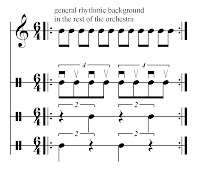
In 20 measures of music (about 40 seconds) Stravinsky combines a BUNCH of patterns (I forget the exact count, and a count is tricky because some are doubled); the following pattern in the percussion is the foundation. The bass drum and tam-tam start before this; the guiro enters at measure 13 (:20) of the section:

When I was studying this as an undergraduate, I made the (typical) mistake of getting lost in the score without listening enough. If you just look at the score, it appears that the percussion instruments are playing "against" the steady eighth notes in the rest of the orchestra. It is actually notated in 4/4 at the beginning of the section, making its significance on paper even less clear:

What is actually taking place is this: the eighth notes are triplets when heard against the percussion. The boom/crash that is set up by the bass drum and tam-tam is further supported by the scraping of the guiro. What is notated like this:


is heard as this:

Which brings me to the drum beat. If you substitute the tam-tam with snare drum and the guiro with hi-hat it sure sounds and looks a lot like this:
a "characteristic drum beat" from Wikipedia

So to me, the "Procession" sounds like a whole bunch of triplets over a huge back beat. Because that's essentially what it is. The notation is slick and misleading, but the effect is very plain.

Saturday, March 10, 2012

She's Gone: a clarification

I need to make a correction and a clarification to my post concerning the lack of a tonic triad in "She's Gone." While it's true there are no authentic cadences, and there are no root position tonic triads, the second chord of the verse is a first inversion I chord (I6, or "E/G#" before the modulation), a passing chord from IV to ii. The same bass motion in "I'm Just a Kid" uses IV, iii, and ii.

I'd also like to mention that the "V sussy" sound is more accurately described as an A chord with a B in the bass ("A/B"). This is a sus7 type sound, yes, but its voicing and (non)resolution (the A triad moves up to a B triad in parallel motion) make the "A over B" label much more descriptive and accurate. And it's easy to play on the guitar.


And I just learned that "I'm Just a Kid" was the B-side for "She's Gone." I am pleased by this.

Monday, February 6, 2012

Have you ever really checked out the bridge to "Oh, Pretty Woman"?

I love Roy Orbison. His songs, his voice, his image and stage presence, etc. Songs like "It's Over," "Crying," "Only the Lonely," "In Dreams," and "Leah" are incredibly well-crafted pieces of melodrama, great songs with great vocals. I've always found "Oh, Pretty Woman" (yes, that's the real title) easy to dismiss. Perhaps I've heard it too many times, perhaps it was that Julia Roberts movie. But it seemed like a throwaway. Then I decided to take a closer listen to the bridge. Oh my.

Can we even call this a bridge? Is there even a chorus? It's almost more accurate to call it through-composed. There are verses, certainly, but then there's this long, two-part "bridge" for lack of a better word. No matter what you label it, the harmony is really interesting both in how it relates to the rest of the song and between the two bridge sections.

First, the move to C major from A major is pretty drastic, especially for a hit like this in 1964. It's interesting to note that C major is the relative major of the parallel minor, A minor. Got that? It comes into play moving into the second section of the bridge. The first section is a simple ii-V-I-vi-ii-V-I progression in C major, coming out of the signature E7 arpeggio bass line pretty much unprepared (though the bass line does feature E-D heavily). Simple as it is, you can also hear it as the doo-wop formula (I, vi, ii or IV, V) displaced by two measures.

As interesting as this new local tonic is, the way he gets back to A major is what really gets me. At the end of the line "Pretty woman say you'll stay with me...eeee" the pitch C rises to C sharp over an A major triad. This moment is so great: are we heading back to D? Is this a secondary dominant? What is this chord about? And then he goes to F sharp minor for the line "Cause I need you"! This is so brilliant! What a bizarre deceptive cadence. Listen to it...that A chord does two things: sets up a vague anticipation that we just might be going back to another D chord AND gets the song back to A major, EXCEPT IT'S EARLY AND COMPLETELY UNPREPARED! By the time the A tonic triad arrives again with "Come with me..." its character has changed completely. Somehow, we are firmly back in the land of A major...EXCEPT THE IV CHORDS ARE MINOR! The D minor chords from the first part of the bridge stay through the second section, though the A chord manages to be the comfy home. The transitional A chord before it is totally uneasy and weird sounding. Isn't it amazing what a good songwriter can do with EXACTLY the same chord in such a short span of time? And doesn't the music just sail on through those two keys? So effective.

The bridge ends with, once again, the doo-wop formula progression I, vi, IV, V, except the D chords are minor, not major. The verses, which I've ignored until now, are also based on the doo-wop progression, a sort of elongated and otherwise adjusted version. Just goes to show you that an understanding, assimilation, and mastery of materials is of primary importance in creative work, no matter how banal the materials are.

Oh, and the second part of the "bridge"? 10 measures long: 3+3+4. So unusual, but completely smooth and slick. So slick I've never noticed it until now. I need to stop, I keep finding new stuff.

Two more comments:
The verses of this song have one 2 beat measure each. Unless you're counting in two, but that doesn't make much sense. Listen for the IV chord.

John Zorn's Naked City uses this classic bass line, in D, as the foundation for their arrangement of Ornette Coleman's "Lonely Woman." Cute, right?

Thursday, February 2, 2012

Holy crap, "She's Gone" doesn't have a I chord, either.

That means that there are two songs, back-to-back, on the Abandoned Luncheonette album that don't have an authentic cadence. In fact, neither song has a tonic chord AT ALL. This is amazing to me. "I'm Just a Kid" dodges the tonic over and over. "She's Gone" seems to substitute a sustained Vsus to V pattern for the I chord.

I get excited about things like this. Judge me as necessary. But this is nervy, risky songwriting.

I prefer the longer, album version, and this audio is junk. but the video is too good.

Friday, January 20, 2012

It is possible to enjoy the music sincerely AND goof on the haircuts.

A few years ago I decided to create sounds (using electric bass and effects) that were inspired by analog synthesizers, especially the Moog bass on Stevie Wonder's Innervisions album and Herbie Hancock's Arp synth bass on "Chameleon." I've had varying degrees of success, both mimicking these sounds and creating new ones. I've used many different effects, done a lot of fussing with settings, used different instruments. Then yesterday I discovered this track and kind of felt like a dumbass, because Pino Palladino gets such a clear, full sound using, from what I can tell, a fretless bass with a lot of high end eq-wise, a little bit of chorus, and a Boss OC-2 octave pedal. It was humbling to hear this track for the first time. Humbling to hear him nail this sort of sound nearly 30 years ago on what could have been a totally forgettable pop track.

A few thoughts:

-Isn't it fun to watch an entire band "lip synch"?
-Is that mic stand made of copper pipe? Jesus, that must be HEAVY!
-I am going to learn every one of the guitarist's sweet, sweet moves.
-I think every synthesizer should be programmed to a default "ugly orchestra hit" patch whenever you slap at it from at least two feet. That would be terrific.
-Why is the other keyboard player so sweaty? Or is he just moisturizing some new ink?
-But seriously...how is it possible that his first generation Boss octave pedal tracks better than my new one? That's ridiculous.
-Without the octave effect his playing would annoy me--too much treble, chorus, wide vibrato--gross (like Paul Young's version of "Everytime You Go Away"--YIKES. Listen to the Hall & Oates version instead.). But with the octave it's juicy synth-town. Love it. And I do give a certain allowance for the meow-bass in 80's pop music (see Duran Duran).
-"Meow-bass" deserves it's own blog entry.
-This video fades just as the bass really takes over. I recommend finding a higher quality audio and checking it out. I do love this one a lot. Do yourself a favor--turn off your 80's irony brain and just love it. Great pop music that happens to be all about the bass. It is possible to enjoy the music sincerely AND goof on the haircuts.